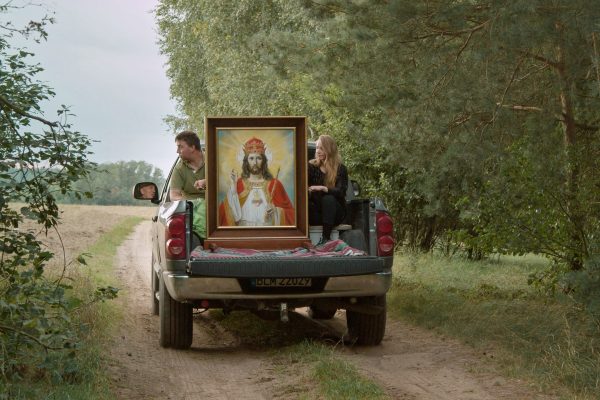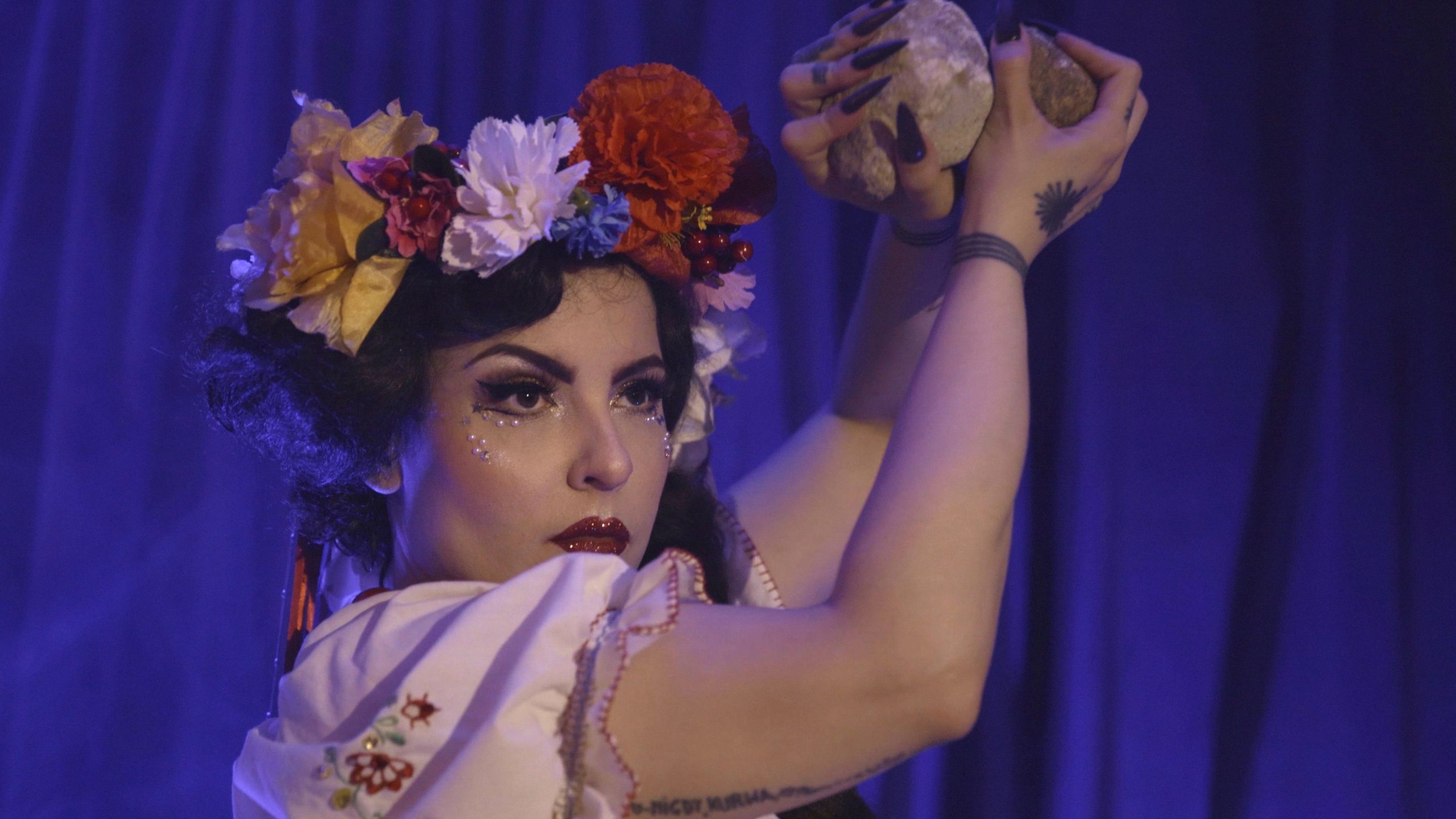
I was born and raised in Poland, and I am not Jewish. I made this film because the history of the Holocaust is also the history of Poland. Bedrock is my debut feature. The six-year journey of making this film opened my eyes to a Poland I had not known before. The fact that, as Poles, we all live on Jewish graves is not a metaphor. The remains are in our land, in the rivers, and in the air.
How can we live in such a country with respect for both the living and the dead? Especially knowing that during the war, Poles were victims, witnesses, and saviors but also perpetrators. We readily speak about the suffering Poles experienced under Nazi Germany, while our complicity in the murder of Jews, as well as the appropriation and destruction of Jewish life and space, is often omitted or denied. Poles committed pogroms before, during, and after the war. Eight decades have passed, and the country seems to have moved on. Yet the past continues to weigh on new generations — and at the center of Bedrock lies a vital question about memory: how do we remember, and to what end?
In the film, a rabbi collecting the bones of Jewish victims says, “I hope this will help. Help you and help us.” To me, he names the fundamental function of remembrance, to support grief, to offer relief, to move toward healing. Yet too often commemoration is misused to maintain a status quo of fear and to cultivate a permanent sense of victimhood.
This dynamic is embodied by people we meet in the film. A Polish grandmother from Jedwabne attends both the prayer for the Jewish victims of the pogrom and the nationalist counter-demonstration. She carries two wounds: the suffering her community endured under Nazi occupation, and the suffering that same community inflicted on its Jewish neighbors. As I watch her struggle to choose a side, I feel that this highly politicized commemoration is designed to feed off her pain and keep her wounds further apart.
On the other hand, Filip, a Jewish man who witnesses the daily devastation of Jewish graves — struggles to find comfort in commemoration at all. Watching him, I felt how remembrance can sometimes turn inward. I see him as someone for whom memory no longer offers grounding, only the risk of becoming all-consuming, a tension that surfaces most clearly when the weight of his work leads him to train with a gun.
A different possibility emerges at the monument in Jedwabne, where a young Polish mother tells her small daughter, “We should love and respect each other.” With these simple words, she interrupts the cycle of competing traumas. For me this is how memory becomes an ethical orientation toward the future, not a prison of wounds. And by no means choosing a different future is at the expense of remembering the past. It asks not only what we owe the past, but how we choose to live with one another now.
When I began working on this film, I had no idea it would lead me to witness new cycles of violence to which our land once again is a witness. As we were filming in Eastern Poland in 2022, a massive wall topped with barbed wire was erected at the Polish–Belarusian border, denying refuge to Black and Brown migrants fleeing wars and persecution. These new “others” follow the footsteps of Jews who once hid in the same place during World War II. As me and my crew walked through Białowieża Forest across sites of Jewish mass graves, we were faced with a real fear of coming across the bodies of migrants. For us, this connection was immediate and visceral. Impossible to ignore. This is not about comparing one suffering to another. It is about blood spilled in the same ground. About recognizing patterns as warning signs. But for many viewers, this juxtaposition feels unsettling.
We have been taught to understand the Holocaust as a singular event — often described as incomprehensible and outside history. Acknowledging its unprecedented scale and honoring its victims is essential. But when it is discussed only within a single, unchangeable frame, it becomes disconnected from critical reflection — and to me, that is always dangerous.
The Holocaust was unprecedented — but Nazism is not an aberration of European “civilization.” It grew out of a longer history of violence shaped by colonial thought, nationalism, racial supremacy, and systematic dehumanization — ideologies first tested and normalized through Europe’s colonial projects. Placing the Holocaust within this broader reflection does not diminish Jewish suffering. It insists that confronting antisemitism must go hand in hand with fighting all forms of racism.
As Polish Jewish philosopher Andrzej Leder argues, desanctifying the Holocaust — removing it from the realm of taboo and inexpressibility — is not a danger, but an opportunity. It allows us to think about mass violence seriously and rationally, to recognize the conditions that made it possible and notice when they reemerge before it’s too late.
Throughout the making of Bedrock and since its release, I have been witnessing how easily fear can be weaponized to justify violence — and how these conditions travel across time and place. When I watch my film today, I can’t help but think of Gaza. Dehumanization is the first step of every genocide. Perhaps only by resisting, at all costs, the temptation to dehumanize anyone — victims or perpetrators — can we begin to break this cycle. Atrocities are not committed by monsters, but by people with agency. Recognizing this offers no justification for unforgivable crimes, but it demands accountability. It also confronts us with the disturbing proximity between ourselves and those who commit them. It is within this shared and unsettling human space that I want my viewers to linger.
I made Bedrock because I believe in the power of careful, attentive observation. Cinema slows us down. It asks us to be present — with images, with feelings, with one another. In a world increasingly shaped by new forms of fascism, where speed and simplification enable dehumanization, paying attention matters. It becomes a form of resistance.